About our geopark
Pauline Coster 2025-05-23T10:14:29+01:00The Luberon UNESCO Global Geopark is located in the southeast of France, in Provence, close to the towns of Aix-en-Provence and Avignon.




The Luberon UNESCO Global Geopark is located in the southeast of France, in Provence, close to the towns of Aix-en-Provence and Avignon.
The Luberon Nature Reserve territory is internationally recognized as an area of significant importance for paleontology since the nineteenth century.
Situated in southeastern France, the Luberon UNESCO Global Geopark is located in Provence, close to the towns of Aix-en-Provence and Avignon. The Geopark is easily accesible.
UNESCO Global Geoparks are territories where sites and landscapes of international geological significance are managed with a holistic concept of protection, education and sustainable development.
On dénombre de nombreux de gisements à vertébrés fossiles sur le territoire du Parc naturel régional du Luberon permettant de reconstituer une partie de la longue histoire des mammifères.
The Salignan mill, a former windmill that has lost its sails and conical roof, houses a small permanent geological exhibition on the division of time in geology and the Aptian stage. Location: Apt Site type: Cultural site - Museum, Scenic viewpoint Visit duration: 1 h30 The Salignan mill is situated on a hill composed of gray marl known geologically as the "Aptian marls." Established in 1840 by Alcide d’Orbigny, the Aptian is one of the stages of the international stratigraphic scale. The site also offers a panoramic 360° view, stretching from the Luberon to Mont Ventoux. Inside the mill, the exhibition explains how early geologists, through the study of rocks and fossils, gradually unraveled Earth's history. It also details why Alcide Dessalines d’Orbigny chose [...]
La région d'Apt est connue dans le monde entier par les géologues ! En 1840, Alcide d'Orbigny, illustre paléontologue, y décrit les marnes grises fossilifères, visibles entre Apt, Gargas et St-Saturnin-lès-Apt, comme référence d'un nouvel étage de l'échelle internationale des temps géologiques : l'Aptien. Depuis, de nombreuses études ont permis d'en savoir plus sur l'âge de ces terrains et l'histoire qu'ils permettent de raconter : la mer en Pays d'Apt il y a environ 120 millions d'années.
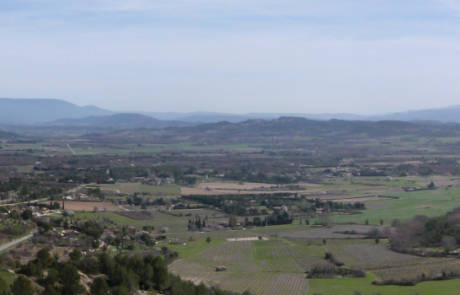
The village of Saint-Saturnin-lès-Apt is located on the southern slope of the Monts de Vaucluse. Built on a rocky spur, it offers an exceptional panorama of the Luberon, the Alpilles, and the Monts de Vaucluse, as well as a stunning view of the plain between Roussillon and Villars. Location: Saint-Saturnin-lès-Apt (84) Site Type: Remarkable village, Scenic viewpoint Visit Duration: 1 to 2 hours Saint-Saturnin-lès-Apt is a quintessential Provençal village nestled on the southern slopes of the Monts de Vaucluse. To the north of the village, the Lower Cretaceous limestone outcrops are visible. To the south, you will find Aptian marls. As you descend toward Apt and Gargas, these marls are covered by alluvium and topped with small hills where tertiary sands, limestone, clays, and [...]
Breathtaking panorama of the village of Gordes, ranked as 'one of the most beautiful villages in France'. Location: Gordes (84) Site type: Remarkable village, Scenic viewpoint The village of Gordes, perched on its rock, is located within the Monts de Vaucluse, between Apt and Avignon. The stunning panorama from Gordes offers breathtaking views of the village and a clear vista of the Calavon Valley extending to the Monts de Vaucluse and the Luberon massif. From here, one can admire the dry stone houses cascading along the streets up to the church and the castle. The village sits on the edge of a plateau made of highly fossiliferous limestone sandstone known as "molasse" or "Pierre du Midi". This rock was deposited in the Miocene sea [...]
Les Rochers de Baude offrent des paysages saisissants avec leurs corniches, falaises et gorges, situées à l'extrémité ouest du Petit Luberon. Un sentier permet de grimper au-dessus de la Source du Boulon, longeant les falaises en balcon sous les Rochers de Baude, offrant ainsi une vue imprenable sur la vallée environnante. Commune : Robion (84) Nature du site : Formation géologique remarquable, Relief remarquable Les rochers de Baude Les rochers de Baude sont constitués d'épais bancs de calcaire érodés, sur plusieurs niveaux, en abris sous roches (baumes). Ces calcaires ce sont formés il y a environ 130 millions d'années dans une mer chaude et peu profonde, comme aujourd'hui aux Bahamas. De nombreux débris d'organismes (coquillages, coraux, etc.) s'y sont accumulés sur de grandes épaisseurs [...]